
Every small business owner hits the same fork in the road. You have a marketing budget, it isn’t unlimited, and two channels are fighting for it. Google Ads promises leads now. SEO promises leads that don’t cost you a click. Which one gets the money first?
The honest answer: it depends on one question most owners never ask. How long can you wait for the phone to ring? Once you answer that, the decision mostly makes itself.
This guide gives you the trade-offs in plain numbers, a simple way to split your budget, and what happened when we ran both channels side by side for the same client.
The short answer
If you need leads in the next 90 days, start with Google Ads. If you can wait six to twelve months and plan to be in business for years, start SEO now, because every month you delay pushes the payoff further out. Most businesses that grow do both: ads pay the bills while SEO compounds.
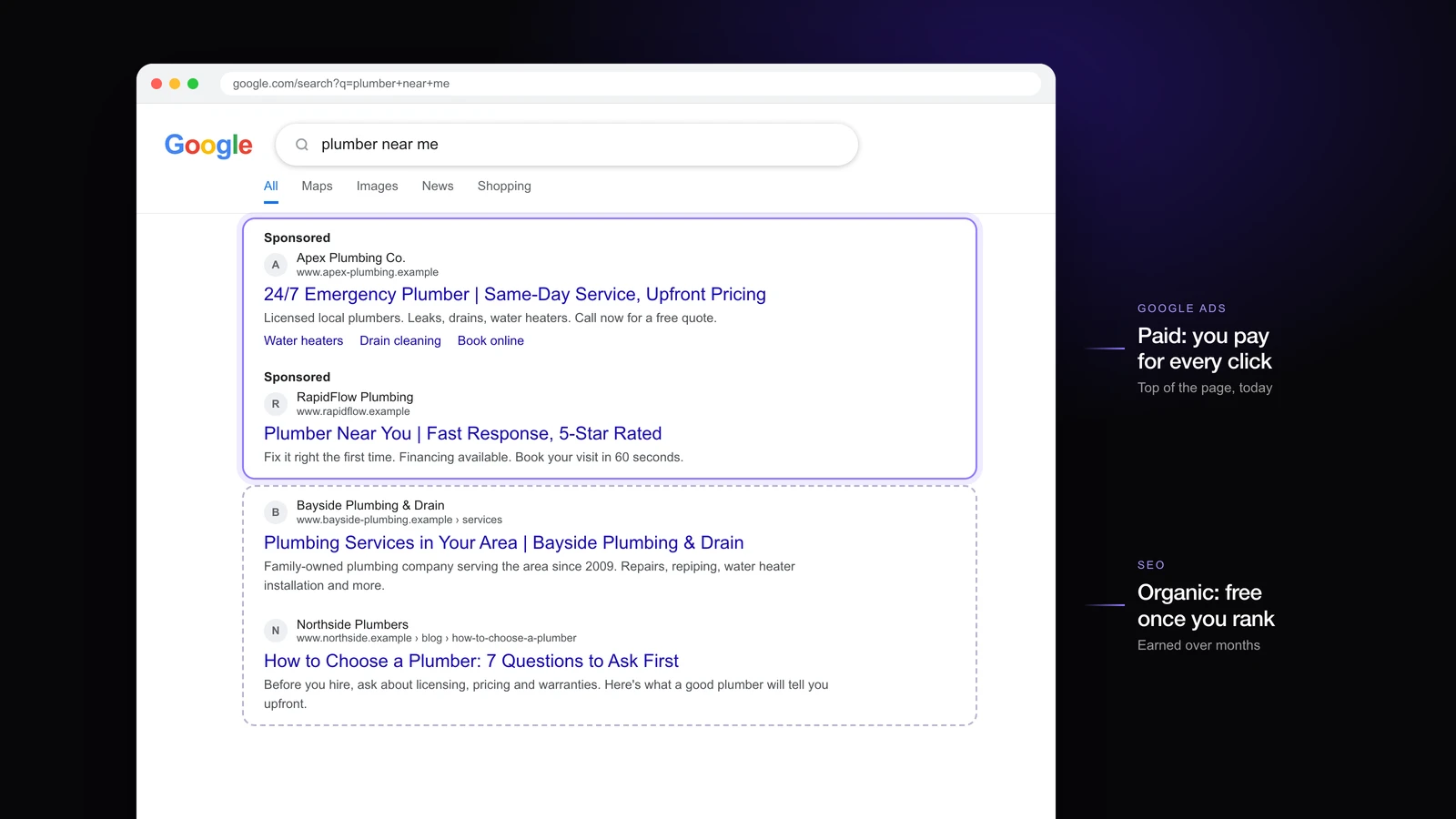
Google Ads: you’re renting the top of the page
Google Ads is the fastest way to put your business in front of someone who is searching for exactly what you sell. Set up a campaign on Monday and you can have calls on Tuesday.
That speed has a price, and you pay it forever. In 2026 the average click across all industries costs $5.42, and the average lead costs $66.69, according to LocaliQ and WordStream benchmarks. In expensive niches it’s much more: lawyers average $9.87 a click. The day you stop paying, the leads stop too.
What Google Ads is great at:
- Speed. You learn which offers, keywords and landing pages convert in weeks, not quarters.
- Precision. You choose the searches, the cities, the hours and the message.
- Testing. Ads tell you what your customers actually want, and that data makes your SEO smarter.
Where it hurts: a poorly run account burns money quietly. Broad keywords, no negative keyword list and “all calls” counted as leads can double what you pay per customer. We wrote a whole guide on that for one of the most expensive niches: how much Google Ads cost for lawyers.
SEO: you’re building the building
SEO is slower because Google has to trust you before it ranks you. That trust takes time to earn, and the data on how much time is sobering.
Ahrefs studied which pages rank in Google’s top 10 across 1.3 million U.S. keywords. Its 2025 update is blunt:
Source: Ahrefs, 1.3M U.S. keywords, 2025.
That sounds discouraging. It’s actually the whole argument for starting early. The pages that rank are old because someone started years ago and kept improving them. Every month you wait is a month your competitor’s pages keep aging and you don’t.
The payoff is real, though. Once a page ranks for a valuable search, every click from it is free. A well-built service page can bring in leads for years, and your cost per lead keeps falling as traffic grows while your spend stays flat.
Ads are rent. SEO is equity. Most businesses need both, in the right order.
The AI Overview problem (and why it doesn’t kill SEO)
There’s a new wrinkle in 2026. For many searches, Google now shows an AI-written answer above the results. Ahrefs found that AI Overviews correlate with a 58% lower click-through rate for top-ranking pages on the queries where they appear.
So is SEO dead? No. But it changed in two ways that matter to a small business:
- Informational searches lost the most. “What is a brand identity” gets answered on the page. “Brand identity agency near me” still gets clicked, because the searcher wants to hire someone, not read a definition.
- Being the source matters. AI Overviews cite websites. Pages that are clear, specific and genuinely useful are the ones that get quoted, and quoted pages earn more clicks than pages that are skipped.
The practical takeaway: aim your SEO at searches with buying intent, such as service pages, pricing and “near me” queries, and write content good enough to be the answer.
How to split your budget
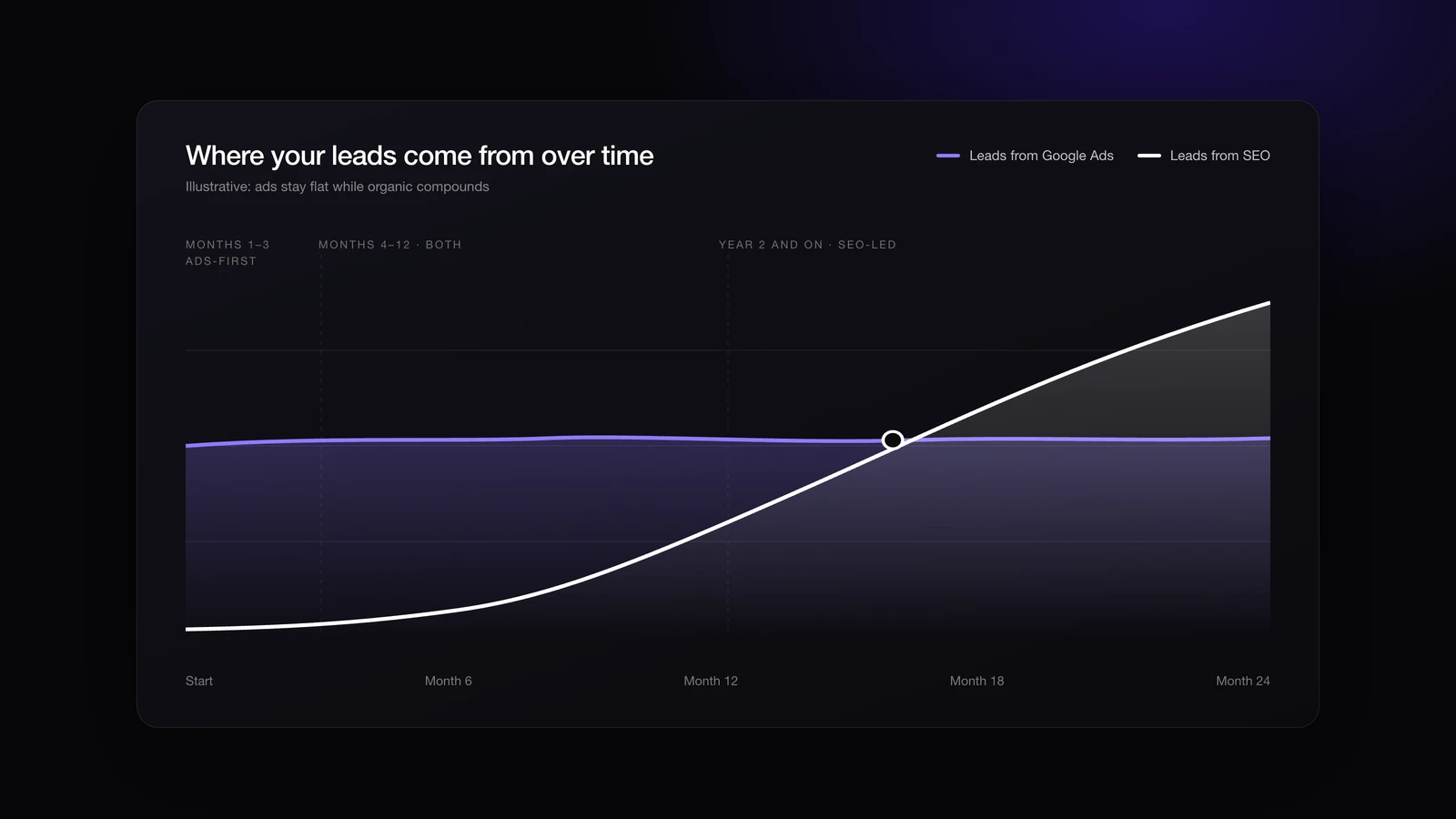
There’s no single right ratio, but there’s a right way to think about it. Start from where your business is, not from what a channel is “supposed” to do.
A typical path for a local service business. The exact split depends on your market and margins.
A few rules we use:
When to start with SEO instead
Ads-first is the default, but not always the answer. Lead with SEO if:
When ads alone are enough (for now)
Some businesses can live on ads for a while: a new location that needs volume immediately, a seasonal offer, or a test of a new service before you invest in pages for it. Just know what you’re buying. Ads give you leads, not an asset. If the account gets switched off, you start from scratch.
What this looks like in a real account
We run Google Ads, SEO and the website for an entertainment law firm in Miami. It’s a good example because both channels were working at the same time, so we could watch how differently they behave.
The ads moved first. We rebuilt the campaigns around the specific services the firm sells and optimized only for qualified calls, and qualified calls grew month after month. SEO took longer to show up, then accelerated: once the service pages were rebuilt and indexed, organic traffic from Google roughly tripled over the summer.
+160% qualified calls from ads, Jan–Sep 2026 vs 2025
That’s the pattern we see again and again. Ads give you a fast, controllable flow of leads. SEO starts slow, and then it starts doing work you no longer pay for per click. Read the full case study.
The questions to ask before you spend a dollar
- What is a customer worth to you? If one customer is worth thousands, paying for clicks is easy to justify. If it’s worth $50, you need cheap traffic, which points to SEO.
- How fast do you need leads? This week means ads. Next year means SEO. Both means both.
- Can you track a lead to a sale? Without that, you can’t tell which channel is actually paying off.
- Do you own your website and ad account? Both channels build value. Make sure that value belongs to you, not your agency.
The bottom line
Google Ads and SEO aren’t rivals. They’re two speeds of the same engine. Ads get you moving today; SEO keeps you moving without paying for every mile. If you can only fund one this quarter, fund the one that matches how long you can wait, and start the other as soon as you can.
Not sure where your budget should go? We'll look at your market, your margins and the fastest path to more customers.
Book a call with PixelcoFAQ
Is Google Ads or SEO better for a small business?
Neither is better on its own. Google Ads is better when you need leads quickly. SEO is better when you want leads that get cheaper over time. Most growing small businesses run ads first and build SEO in parallel.
How long does SEO take to work?
Usually months, not weeks. Ahrefs found that only about 1.74% of new pages reach Google’s top 10 within a year, and most top-ranking pages are more than three years old. Low-competition local searches can move faster.
How much does Google Ads cost for a small business?
The 2026 average is $5.42 per click and $66.69 per lead across all industries, according to LocaliQ and WordStream. Your cost depends on your industry, location and how well the account is managed.
Can I do SEO and Google Ads at the same time?
Yes, and that’s usually the best approach. Ads data shows which searches turn into customers, and those are the pages worth building for organic search.
Is SEO still worth it with AI Overviews?
Yes, if you focus on searches with buying intent and create content clear enough to be cited. Informational searches lost the most clicks to AI answers. Searches from people ready to hire still get clicked.